
For Brazilian investors, investing at home often feels like the natural starting point. The local market is familiar because it reflects the economy, currency, interest rates and companies that are part of everyday life in Brazil. But focusing only on domestic assets may limit the range of markets, sectors and currencies investors can incorporate into a portfolio.
International markets, including the US market, can help broaden that perspective. Global markets provide access to companies, sectors, currencies and economic trends that may not be fully represented in Brazil. The goal is not to choose one market over the other, but to understand how Brazilian and US markets can play different roles within a diversified investment approach, and how they may together offer investors a wider view of the global investment landscape.
One of the clearest differences between the two markets is scale. The US represents the world’s largest stock market by total market value, while Brazil accounts for a much smaller share of global listed stocks.
That difference matters because larger markets often include more companies, more sectors and more business models. A broader opportunity set may help investors diversify beyond the companies and industries that dominate the local market.
To illustrate this difference in scale, we can compare the market value of the three largest companies in each country:
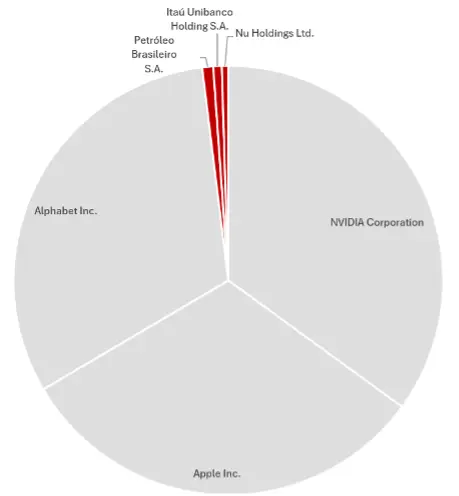
Source: Public information, as of 8 September 2026
Scale alone does not make an investment more attractive, however. Large markets can still be volatile, large companies can still decline in value, and international investing may involve additional considerations such as currency fluctuations, tax treatment, regulatory differences and political or economic risks. Still, market size helps explain why international exposure may provide access to companies and sectors that are less represented in Brazil.
Different markets are shaped by different sectors. In Brazil, major equity indexes often have meaningful exposure to financials, commodities, energy and a relatively small group of large companies.
In the US, investors can access a broad range of industries and business models, including technology, health care, communications, consumer companies and global industrial businesses. Many large US companies also generate revenue in multiple countries, which may result in business performance being influenced by a variety of economic conditions rather than one local market alone.
Even in a broad market like the US, some indexes can become heavily influenced by a small group of large companies. This helps explain why the Magnificent Seven, or Mag7, has appeared frequently in discussions about the US market in recent years.
Diversification can help reduce concentration risk, but it does not eliminate market risk or guarantee positive returns.
Both Brazil and the US have regulated capital markets, but their structures differ. In the US, major exchanges such as the New York Stock Exchange and Nasdaq list thousands of companies across a wide range of sectors.
In Brazil, B3 is the central exchange for listed stocks and related market infrastructure. It lists fewer companies than the major US exchanges.
The key point is not the number of regulators or market entities, but that the US market offers broad listed-company access. This compares with Brazil’s market, which is more concentrated and more closely tied to local economic conditions.
Some Brazilian investors may view local instruments that provide exposure to US stocks, such as BDRs, as similar to investing directly abroad. While both may provide exposure to international companies, the advantages and disadvantages of each approach can vary depending on factors such as fees, liquidity, currency exposure, account structure, tax treatment, investment objectives and local market risks.
For Brazilian investors, investing internationally typically introduces exposure to the US dollar, one of the world’s primary reserve currencies and a key medium of exchange in global trade and finance. As a result, investment returns are influenced not only by the performance of the investments held, but also by movements in the exchange rate between the US dollar and the Brazilian real.
Foreign-currency exposure can play an important role in portfolio construction. Many global companies generate revenues across multiple regions, currencies, and economic environments, providing investors with access to opportunities beyond the domestic market. In addition, investing in US dollar-denominated assets may provide exposure to a widely used global currency, while also helping diversify portfolio currency exposures beyond the local market. This broader currency exposure can be particularly relevant during periods of local market volatility, inflationary pressures, or shifts in domestic monetary policy.
The objective is not to speculate on currency movements, but rather to diversify the portfolio across different sources of risk and return. By combining assets linked to different economies, sectors, and currencies, investors can build a more balanced portfolio designed to navigate a wider range of market environments.
However, currency exposure can work both ways. While a stronger US dollar may enhance returns when converted into reais, a weaker dollar may reduce them. For this reason, international investments should be evaluated within the context of a long-term investment strategy and overall portfolio diversification objectives.
Estimate the value of an amount when converting between US dollars and Brazilian reais.
1 USD = 5.0000 BRL
Enter a rate greater than 0.
Changes in the USD/BRL exchange rate can increase or reduce the value of international investments when converted between US dollars and Brazilian reais.
Currency exchange rates may fluctuate significantly over short periods of time and may affect the value of investments denominated in foreign currencies. Currency movements may increase gains or losses when investment returns are converted into another currency. Exchange-rate fluctuations are difficult to predict and may be influenced by economic, political and market conditions.
A dollar-based investment is influenced by global markets and exchange rates, while investments tied primarily to Brazilian economic conditions may be affected differently by domestic rates, inflation and country-specific factors.
International investing can be an important component of a well-diversified portfolio, as it provides exposure to different economies, industries, market cycles, and currencies. For Brazilian investors, global investments may help reduce reliance on domestic factors such as inflation, interest rates, political developments, and other market-specific events that can influence local asset performance.
However, diversification does not eliminate risk or guarantee positive returns. International investments remain subject to market fluctuations, economic and geopolitical events, and currency movements, all of which can result in gains or losses.
For Brazilian investors, the US market offers access to the world’s largest capital market, a broader universe of companies, and sectors that are underrepresented or unavailable in Brazil, such as technology, healthcare, and global consumer brands. It also provides exposure to the US dollar, one of the world’s most widely used reserve currencies.
In contrast, the Brazilian market is primarily influenced by domestic economic factors, including inflation, interest rates, fiscal and political developments, and local business conditions. While these factors can create attractive investment opportunities, they can also increase portfolio concentration when a significant portion of assets are invested in a single market and currency.
The objective of international investing is not to replace Brazilian assets, but to complement them. By combining investments across different markets, currencies, sectors, and economic cycles, investors can build a more resilient and diversified portfolio with multiple potential sources of return. When evaluating international investments, it is important to look beyond absolute performance. This broader perspective can help investors make more informed decisions and align their portfolios with their long-term financial objectives.
This material is provided for general informational and educational purposes only and does not constitute investment advice, a recommendation, or an offer to buy or sell any security, investment product, or strategy.
The information presented is not personalized and does not consider an individual’s financial situation, investment objectives, risk tolerance, or time horizon. As a result, the content may not be suitable for all investors.
The views expressed are those of the author and do not necessarily reflect the official position or recommendations of Bradesco Investments, Inc. Views and information are subject to change without notice.
All investing involves risk, including the possible loss of principal. Asset allocation and diversification strategies do not guarantee profits or protect against losses. Past performance is not indicative of future results.
Investments outside the United States may involve additional risks, including currency fluctuations, political or economic instability, and differences in regulatory, legal, or accounting standards.
This content is not intended to replace professional advice. Investors should conduct their own research and consult with qualified and licensed financial, tax, or legal professionals before making any investment decisions.
You are leaving Bradesco Bank’s website
IMPORTANT NOTICE
By selecting Continue you will leave bradescobank.com and go to a website that we do not own or control. We do not endorse and are not responsible for the products, services or information you may find there. This other site may not follow the same privacy policies and security procedures that we do, so please review its policies and procedures carefully.
You are leaving Bradesco Bank’s website
IMPORTANT NOTICE
By selecting Continue you will leave bradescobank.com and go to an affiliate website that we do not own or control. This other site may not follow the same privacy policies and security procedures that we do, so please review its policies and procedures carefully.
You are leaving Bradesco Bank’s website
IMPORTANT NOTICE
By selecting Continue you will leave bradescobank.com and go to a website that we do not own or control. We do not endorse and are not responsible for the products, services or information you may find there. This other site may not follow the same privacy policies and security procedures that we do, so please review its policies and procedures carefully.
You are leaving Bradesco Bank’s website
IMPORTANT NOTICE
By selecting Continue you will leave bradescobank.com and go to a website that we do not own or control. We do not endorse and are not responsible for the products, services or information you may find there. This other site may not follow the same privacy policies and security procedures that we do, so please review its policies and procedures carefully.
IMPORTANT NOTICE
Please note that some links within this document may direct you to a website that we do not own or control. We do not endorse and are not responsible for the products, services, or information you may find there. This other site may not follow the same privacy policies and security procedures that we do, please review its policies and procedures carefully.
You are leaving Bradesco Bank’s website
IMPORTANT NOTICE
By selecting Continue you will leave bradescobank.com and go to a website that we do not own or control. We do not endorse and are not responsible for the products, services or information you may find there. This other site may not follow the same privacy policies and security procedures that we do, so please review its policies and procedures carefully.